What is Crypto Bubbles? The crypto market drawn as bubbles
A thousand coins on one board: the bigger the bubble, the bigger the coin; the greener it is, the more it gained. This guide explains where the project came from, why your brain reads it faster than any table, who it's for — and what it definitely is not. Along the way: two real bubbles from crypto history, because the app's name is no accident.
Crypto Bubbles in plain words: what it is and where it came from
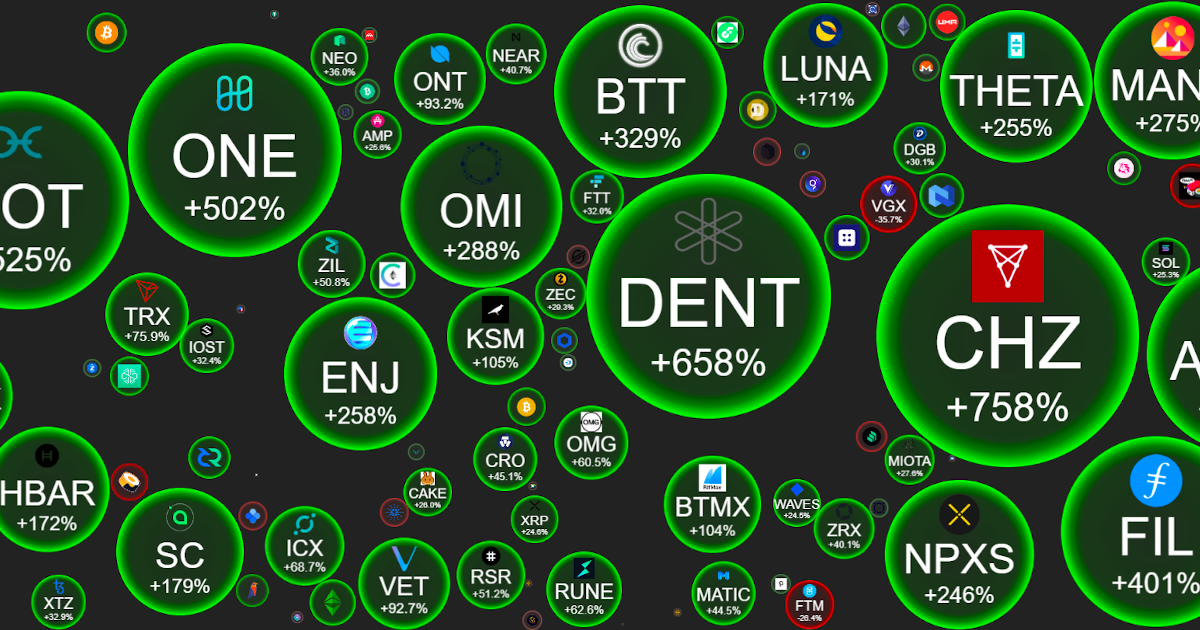
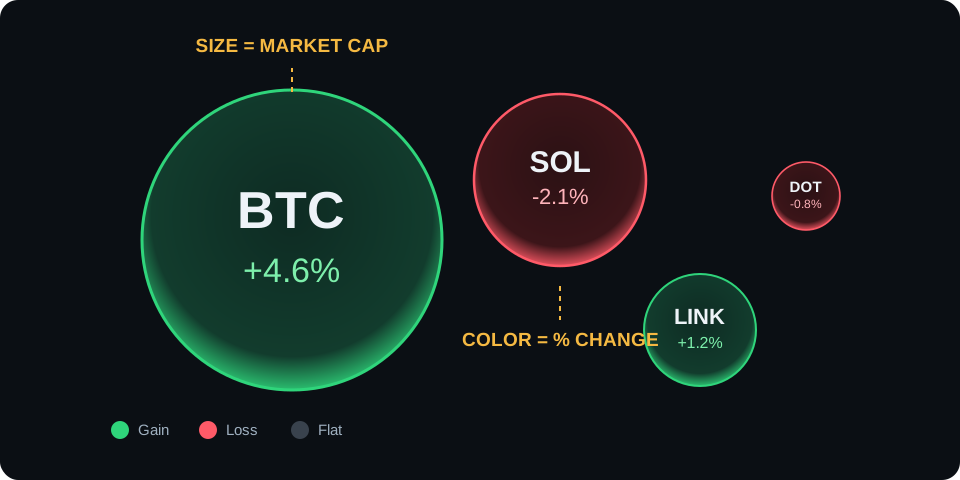
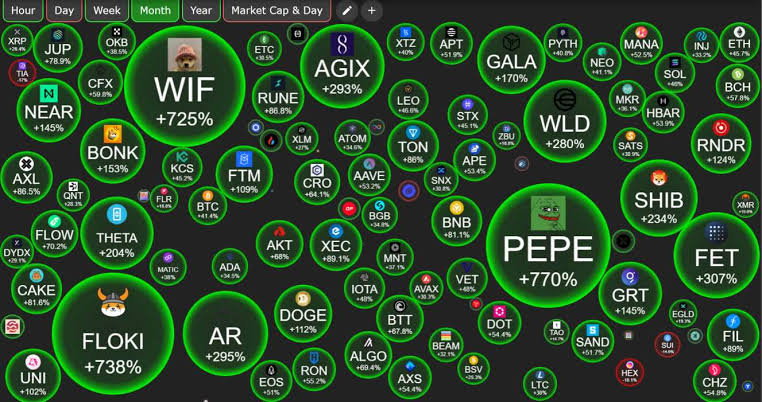
The simplest version: Crypto Bubbles is a free app that draws the cryptocurrency market as a board of colored bubbles. Each bubble is one coin. Its size corresponds to market capitalization — the total valuation of the project — and its color and intensity show the percentage price change over a chosen time window, from an hour out to a full year. Instead of reading a thousand table rows, you look at one screen and know in a second whether the market is celebrating or bleeding.
The project's story is pleasantly atypical for crypto: no ICO, no token, no profit promises. Behind the app is an independent developer in Germany who built the web version first and added iOS and Android apps only after it caught on — details which, like every product fact in this article, we attribute to the official cryptobubbles.net site. The tool spread organically because it does one thing and does it very well: it shows you the state of the market faster than you can finish asking the question.
Let's set expectations immediately: this is a viewer. Crypto Bubbles doesn't sell crypto, doesn't hold it, and doesn't advise. That's exactly why using it requires no account, no phone number and no scan of your ID — the app never touches your money, so there's nothing for KYC procedures to protect. A healthy rule for your whole crypto life: the less a tool knows about you, the better, as long as it isn't holding anything of yours.
Why bubbles work: two seconds ahead of consciousness
This visualization's appeal has solid grounding in perceptual psychology. Size and color belong to what researchers call preattentive attributes — the brain processes them automatically, in a fraction of a second, before you consciously "read" the image. You find the largest object on screen and the brightest color effortlessly, by reflex. Numbers work the opposite way: each one has to be read, interpreted and compared with its neighbor, and working memory handles a handful of values at once, not a thousand.
So a bubble board offloads the entire job of comparison from your conscious mind onto your visual system. A red sea with one green island; a memecoin flaring like a signal rocket after a 60% run; a Bitcoin giant next to which the fashionable token of the month looks like a pea — all of that is information you see before you can think. The same principle is why a weather map beats a table of temperatures and a subway map beats a timetable.
The board's entire grammar in one picture: size = market cap, color = direction and scale of the price change.
According to the official cryptobubbles.net site, a handful of features make up the core of the app — each has its own guide here, so this is just the lay of the land:
The bubbles view — more than a thousand coins on one board, refreshed automatically every few dozen seconds. The heart of the app and the subject of our bubble chart guide.
Time windows — hour, day, week, month, year. The same board tells a completely different story in each: the hourly window is pulse and noise, the yearly one is a survival test. Learning to juggle windows is half the tool's value.
Coin cards — clicking a bubble opens the details: price chart, market cap, volume, rank. The board is a table of contents; the card is the first paragraph of research.
Watchlists — your own slimmed-down view instead of the entire market. Less noise, more meaning.
Price alerts — notifications on your phone instead of compulsive refreshing. Setup is covered in our app guide.
Feature scope, coin count and platforms of the official app — attributed to cryptobubbles.net (as of July 2026).
Five time windows — five different stories about the same market.
Who the tool is for (three real scenarios)
A beginner gets something priceless: orientation. Before you invest a single dollar, you can spend a month watching the market breathe for free — what euphoria days look like versus panic days, how genuinely enormous Bitcoin is next to everything else, how fast yesterday's stars burn out. It's the cheapest lesson in humility the industry offers. A trader uses the board as an anomaly radar: an outlier bubble is a "check me" signal before the story reaches the headlines. A journalist or analyst gets a market snapshot in a second — one board says "broad sell-off with rotation into large caps" faster than any report will.
What Crypto Bubbles is NOT — the mandatory section
We give this its own block, because confusing categories of tools costs real money in crypto:
It is not an exchange. You can't buy or sell anything here. Transactions need an account at a crypto exchange — a separate service with regulation, KYC and its own risks.
It is not a wallet. The app holds no funds and will never ask for a seed phrase. If some "version of Crypto Bubbles" asks for a seed phrase or card details, that's phishing — close the tab.
It is not an advisor. Colors describe the past. Green means "went up," not "will go up." The board generates no buy signals, and no honest visualization does.
It is not a complete data source. Liquidity, tokenomics, supply unlocks, wallet concentration — none of that is readable from a bubble. For checking valuation proportions there's the CoinCompare calculator; for deeper research, aggregators and project documentation.
Remember one sentence: Crypto Bubbles shows what happened — never what will happen. Using the board as an oracle is a user error, not a tool defect.
Free and ad-supported: what that means for you
Worth being explicit about the business model, since "free" always has a mechanism behind it. According to cryptobubbles.net the project is ad-supported. That's the honest end of the spectrum for a free tool: nobody is monetizing your trades, because there are no trades, and nobody needs your identity documents, because there's no money movement to verify. Compare that with the alternative models the industry has tried — paid signal groups, referral funnels into leveraged products, "free" apps that sell order flow. An ad banner is a considerably cheaper price to pay.
The practical consequence is worth naming too: ads inside a crypto app are frequently ads for crypto products, and those are not vetted by the app's developer. Treat any promoted token, airdrop or "guaranteed yield" you meet in an ad slot exactly as you'd treat it anywhere else on the internet — with the assumption that the person paying for the placement is not paying for your benefit.
The pun
"Crypto bubbles" — circles on a screen and bubbles in history
The app's name is a neat piece of irony, because the phrase "crypto bubbles" has a second, older meaning: speculative bubbles, which this market is famous for like no other. A bubble is a stretch of time when prices detach from any sensible valuation, driven purely by the belief that somebody will pay more tomorrow. Crypto's history has several; two are worth knowing, because they teach more than most investing courses.
Case study 1: the ICO mania, 2017. A PDF grandly labeled a "whitepaper" and an ERC-20 token thrown together over a weekend were enough to raise millions of dollars from strangers on the internet. Projects promised to revolutionize everything from logistics to lettuce, and total market capitalization multiplied more than tenfold in a year. The ending: in 2018 the market gave up the overwhelming majority of that value, and a huge share of the tokens from that wave never came anywhere near their highs again. The lesson: capital flowing indiscriminately into everything is not a bull market, it's a bubble.
Case study 2: leveraged euphoria, 2021. This time the fuel wasn't ICOs but leverage and cheap money: 20x futures, loans collateralized by tokens, "stable" protocols promising low-double-digit annual yields with no risk. When prices twitched downward, a cascade of forced liquidations wiped out, one after another in 2022, an algorithmic stablecoin, several funds and several exchanges that a quarter earlier had been treated as pillars of the industry. The lesson: leverage doesn't create value, it creates a queue for the exit — and the exit gets too narrow at precisely the moment everybody wants to use it.
And here's where the app comes back in: the bubble board is, perversely, a decent bubble barometer. When every time window glows lush green and memecoins are outrunning the entire rest of the market, history suggests caution rather than euphoria. How to read those sector rotations on a wide board is covered in our market map guide.
One historical caveat, because cynicism should cut both ways: "this looks like a bubble" is not a timing tool. Plenty of markets have looked overheated and then doubled before breaking. The board tells you what regime you're in; it does not tell you how long the regime lasts. Anyone who claims otherwise is selling something.
Exchange or personal safe: custodial vs non-custodial
Since Crypto Bubbles holds nothing, sooner or later you'll face the question of where to keep the coins you buy. There's one fundamental distinction. A custodial arrangement — an exchange account — works like a bank: the operator holds the keys, you have a login, a password and a way to recover access when you forget it. Convenient for trading, but your funds are exactly as safe as the operator is safe (and honest). A non-custodial arrangement — a wallet like MetaMask, or a hardware wallet — is a personal safe: only you hold the keys. Total control, and also total responsibility: a lost seed phrase means funds gone permanently, with no support hotline to call.
A sensible setup for most people: buy and trade on a regulated exchange with 2FA switched on, and move larger amounts you don't plan to touch for months into a wallet whose keys you hold. Not because exchanges "will definitely fail" — because 2022 demonstrated that they can.
Crypto Bubbles, CoinMarketCap or an exchange terminal?
These three tools get lumped together, but they answer three different questions: "what's happening?", "what is this?" and "how do I execute?"
Criterion
Crypto Bubbles
CoinMarketCap / CoinGecko
Exchange terminal
Core question
What's happening in the market?
What is this project? What are its numbers?
What price can I buy or sell at right now?
Format
A board of bubbles
Tables, rankings, coin profiles
Candles, order book, order form
Time to first conclusion
Seconds
Minutes
Minutes to hours (needs practice)
Depth of per-coin data
A basic card
Full: supply, pairs, exchanges, links
Full market depth: liquidity, spread, book
Executes trades
No
No
Yes
Account / KYC required
No (for viewing)
No (for viewing)
Yes
Best for
Fast orientation, anomaly radar
Project research
Executing decisions
A mature workflow uses all three in sequence: bubbles catch the topic, an aggregator lets you check it, an exchange — if the research holds up — executes. Skipping the middle step is the most popular shortcut to losses.
Your first week with the board, without spending anything
If you're starting from zero, here's a week that costs nothing and teaches more than a shelf of books. Days one to two: only look at the day window, and only answer one question — is the board mostly green or mostly red? Say it out loud. You're building a baseline. Days three to four: add the week window and compare. You'll discover coins that look great today and terrible over seven days, which is the first genuinely useful insight the board gives anyone. Day five: pick the three biggest movers and open their coin cards. Don't buy anything; just read what happened. Days six to seven: build a watchlist of ten coins you can explain to a friend in one sentence each. If you can't explain it, it doesn't go on the list.
At the end of that week you'll have something most people who've been in crypto for years lack: a sense of what a normal day looks like. Everything else — indicators, strategies, narratives — is easier to evaluate once you have that baseline. And it's worth repeating that none of it required an account, a deposit or a single transaction.
Three myths worth deleting early
"A big green bubble means a good project." Size is capitalization and color is recent history. Together they say a large project went up. Neither says it's well built, fairly distributed or liquid enough to exit.
"If it's on the board, it's been vetted." Inclusion follows market cap and data availability, not quality. The board is a mirror of the market, and the market lists plenty of things you shouldn't own.
"Bubbles are for beginners, pros use candles." Professionals use overviews constantly — that's what a trading desk's wall of screens is. The board is a different altitude of the same map, not a simpler version of it.
The short version of this page
Crypto Bubbles is a free crypto market visualization: bubble size = market cap, color = price change over the chosen window.
Built by a German developer: web first, then iOS and Android; more than a thousand coins (facts attributed to cryptobubbles.net).
It works without an account or KYC because it holds nothing — it is not an exchange, not a wallet, not an advisor.
The name is a pun: bubbles on screen and the speculative bubbles in market history — 2017 and 2021 are required reading.
Bubbles are a radar; use aggregators for research, an exchange to transact, and ideally your own wallet to store.
FAQ
Frequently asked questions about what Crypto Bubbles is
What is Crypto Bubbles in one sentence?
It is a free app that visualizes the crypto market as a board of bubbles, where a bubble's size corresponds to a coin's market capitalization and its color to the coin's price change over a chosen time window. Available in the browser and on iOS and Android, it covers more than a thousand coins according to the official cryptobubbles.net site.
Who created Crypto Bubbles?
The project comes from an independent developer in Germany. The app started as a web tool, and the iOS and Android versions arrived later — details we attribute to the official cryptobubbles.net site, which remains the only source of truth about the product.
Is Crypto Bubbles free, and does it require registration?
Yes, it is free — the project is ad-supported, as cryptobubbles.net states. Simply watching the market needs no account and no identity verification, because the app never touches your money. An account only becomes relevant for syncing watchlists across devices.
Can I buy or store crypto through Crypto Bubbles?
No. Crypto Bubbles is not an exchange, not a wallet, and it executes no transactions — it is purely a view of market data. Buying requires an exchange account, and self-custody requires a non-custodial wallet whose keys only you control.
Where does the name Crypto Bubbles come from?
It is a pun. Bubbles are literally the circles on the board, but also the speculative bubbles crypto is famous for — like the 2017 ICO mania or the leveraged euphoria of 2021. The name ironically ties the shape of the visualization to the nature of the market it visualizes.
How is Crypto Bubbles different from CoinMarketCap?
It answers a different question. CoinMarketCap is the market's encyclopedia: tables, rankings, detailed data on every coin. Crypto Bubbles is a glance: one board showing what is happening across the whole market in a second. In practice the two complement each other — bubbles as radar, tables as magnifying glass.
Seen enough bubbles? Take the next step carefully.
A month of watching the market costs nothing. When you're satisfied you understand what you're looking at, pick a regulated exchange, turn on 2FA, and start with an amount whose loss wouldn't ruin your week.